Grad programme

Launch your career in Investment Banking with Santander

We are looking to hire talent to be the future leaders of Santander Corporate & Investment Banking (Santander CIB) through our Graduate Programme.

Our international graduate programme offers you a unique experience in a global investment bank. You will join a diverse and dynamic team, that will provide learning and development opportunities to grow both professionally and personally.

In your first year with us, you will gain an all-round understanding of the investment banking business through immersive training, participating in an array of exciting projects and initiatives.

We are looking for the best talent to support our growth ambition. Recent graduates or final-year students who are highly motivated to bring out-of-the-box perspectives. A strong educational background in Engineering, Mathematics, Statistics, Finance, Business Administration or Economics is needed.

Why Santander CIB? We are part of one of the world’s leading financial services groups. With the business transformation that we started a couple years ago we have grown and diversified our franchise, and we have tightened our partnership with our clients becoming a key industry player, committed to delivering best-in-class solutions, including those required to accelerate the path to more sustainable business models.

Joining Santander CIB means becoming part of a world-class team that supports the growth strategy of major companies and institutions by providing innovative and tailor-made solutions. A unique opportunity to join an international network of experts that will help you take your career to the next level.

Applications are now open. If you are looking for a career in banking to make a difference, we would like to hear from you.

Click here to apply

Grads Programme


image

Digitise-to-distribute: How technology is expanding the scope of trade finance investors

Alternative investors are key contributors in bridging financing gaps and transforming industry dynamics. The team at Santander CIB highlights the role of digitisation in attracting new entrants to the trade finance market.

Digitisation in trade finance is a hot topic for an industry that has for centuries relied on paper and whose multiparty and cross-border nature poses significant obstacles to streamlining and automating its processes.

Despite being a challenging ambition, the benefits for corporates and banks of investing in new technology are enormous: it significantly reduces time, costs and operational errors, thus increasing efficiency and maximising volumes, which ultimately makes participation in international trade and access to competitive financing more inclusive.

Because of its plethora of advantages, the digital transformation of trade is speeding up. Those players who are not able to keep up with the latest technological advances risk losing competitiveness and being sentenced to disappear in the long term. Santander Corporate and Investment Banking (Santander CIB) is committed to pioneering this new environment and anticipating the needs arising from the digitisation journey its clients have embarked on.

“As a global bank, we have the right infrastructure, capital and risk management capabilities to position ourselves at the centre of the ecosystem and act as anchors for our corporate clients to connect them to all of the different players in the trade finance arena and provide them with the best value proposition,” says Enrique Rico, global head of trade and working capital solutions at Santander CIB.

This collaborative approach has led the team to become investors in trade finance platform Komgo, partner with fintech Two and insurer Allianz Trade to support clients in increasing their digital B2B sales, and ally with software provider SAP to embed their receivables and supply chain finance solutions into corporates’ ERPs.

Unlocking the power of digitisation

But digitisation not only boosts collaboration among the financial and technological industries. It also enables banks to form intra-industry partnerships that offer larger and more comprehensive trade finance solutions, meeting all client needs and simplifying their lives.

The latest technological developments have propelled the standardisation and automation of processes and templates, significantly enhancing banks’ syndication and distribution capabilities. This transformation has unlocked the potential of trade finance assets, which have been traditionally very difficult to distribute.

“The originate-to-distribute model most big banks follow is vital for financial institutions to comply with capital requirements, manage credit risk and ensure liquidity,” says Rico. “But being able to structure a multi-bank solution is also key for our clients, especially when we are talking about large multinationals in need of centralising the trade finance and working capital requirements of their different subsidiaries,” he adds.

Multi-funder programmes are inevitable when attempting to achieve the scalability and broad geographical scope that most big corporates demand. Diversifying the pool of funding sources also contributes to underpinning a programme’s resilience and flexibility to meet peak utilisation.

“We have recently closed a multi-billion supply chain finance facility with a major energy player including several buying entities located in three different continents,” explains Ángel Bustos, global head of supply chain finance at Santander CIB. “Without a multibank approach, no institution would have had such a massive appetite for a single group and the company would have been forced to manage several facilities, each with its own platform, legal documentation and operational processes.”

Santander CIB’s multi-funder supply chain finance platform

With its multi-bank white-label digital platform, Santander CIB offers its clients the possibility of structuring global facilities with a single point of entry and seamless process. Both buyers and suppliers deal exclusively with Santander CIB as fronting bank, while the other funders benefit from a digitised process under which invoices are automatically assigned, sold and finally paid to each participant according to their quota.

To achieve this, the bank has consistently invested an average of US$20mn annually over the past years in cutting-edge technology to fully digitise its supply chain finance platform, simplify the supplier onboarding and payment processes, and open it up to other banks and investors.

“Alongside other major connectivity achievements, like the integration of our solution into the clients’ ERP, the multibank funding structure we have implemented has been an inflexion point in our offering,” says Bustos. “Thanks to a flexible and automated distribution model, we have expanded the possibilities of participation alternatives for investors in terms of countries coverage, currencies, appetite, and funded or unfunded options.”

Even the buyer can invest its own excess liquidity in its programme via a dynamic discounting module that allows it to buy back discounted invoices before the maturity date.

The bank estimates that two in three supply chain finance programmes will include a multi-funder approach by 2025. This is a major win for trade finance assets, which have been traditionally very difficult to distribute, mainly because of the lack of automation and harmonisation.

New investors expand trade finance horizons

Despite their anticyclical behaviour and low-risk profile – attributable to their commercial basis and short-term nature – trade finance assets have significantly less access to capital markets compared to other financial assets, such as mortgages or bonds.

This trend, however, has been shifting lately, with many private equity funds and asset managers showing interest in the multi-trillion-dollar, self-liquidating asset class of trade finance. As an example, Santander Alternative Investments recently created two funds to allow investors access trade finance assets and its “low default rates and high recovery rates”.

“The entry of private investors into the trade finance space is excellent news for traditional banks, since the current scale of the trade finance distribution universe is not enough to meet the increasingly tighter capital requirements and faces liquidity constraints,” explains Rico.

“Non-bank investors are helping banks alleviate these limitations, but more importantly they are opening new roads of origination and will bring alternative sources for growth.”

Indeed, emerging trade finance investors are poised to inject fresh capital into the current trade finance landscape, reigniting an appetite for developing countries, sub-investment grade companies, and SMEs – markets traditionally challenged in accessing financing. As they expand the scope of origination for banks, alternative investors play a crucial role in bridging the US$2tn trade finance gap.

However, for the distribution process to function effectively, participants cannot rely on manual intervention.

With increasing volumes and a growing number of investors, having robust technological infrastructure becomes essential. Only banks committed to digitisation will be positioned to lead this transformation and assume a central role in the evolving trade finance ecosystem.

At Santander CIB, we have warmly embraced this call to action.

heading

Buy Now Pay Later: alternative funding for SMEs amid economic turmoil

World economy is going through challenging times. Recessions in the past have shown that small and medium-sized enterprises (SMEs) can be highly dependent on bank financing, and thus more sensitive to interest rates, compared to larger firms, who have a broader access to capital markets and higher access to credit.

According to insurer Allianz Trade, the macroeconomic turmoil is widening the trade finance gap, which is estimated to worth over $2 trillion for world’s SMEs and could lead to a 21% rise in SME insolvencies in 2023. In the current context, as SMEs anticipate the risk of facing future financing constraints, they will react by holding higher cash reserves and increasing their focus on managing their cashflows. This macroeconomic environment has led to an increased interest in B2B Buy Now Pay Later solutions, already gaining popularity as B2B e-commerce boomed.

These solutions allow for corporates to provide payment terms to SMEs (making them a more attractive seller and increasing sales) whilst mitigating the increased risk (receivables can be immediately purchased by the bank absorbing the corporates’ exposure to its buyers insolvency). BNPL represents a mutually beneficial solution to both seller and buyers.

Sellers using BNPL can benefit from;

  • Higher revenues; increased basket size, buyer loyalty and stickiness
  • Credit Risk transferred 
  • Streamlined order-to-cash process with upfront financing 
  • Focus on business growth, while outsourcing time consuming processes such as collection and reconciliation processes 
  • Cost often more competitive than credit card charges 
  • while benefits to the buyers include; 
  • Access to embedded financing (trough extended payment terms with higher acceptance rate)
  • Flexible liquidity; faster short-term financing for B2B customers and often at lower cost than traditional financing 
  • Enhanced purchase experience with seamless, fully digital check-out experience 

With 360 million users worldwide, BNPL has become one of the fastest growing payment methods over the past two years – the BNPL market value has nearly doubled between 2020 and 2022 and the global B2B e-commerce market is forecast to grow at 17% until 2030. B2B sellers are now more likely to offer e-commerce channels than in-person selling.

According to B2B BNPL platform provider ‘Two’, e-commerce businesses who have implemented the solution have seen conversion rates go up by +20% and  average order values increase by 60-75%.

BNPL integrates into an e-commerce platform, providing an alternative to Credit Card payments. For clients, it is a seamless payment method with a number of benefits over the alternatives. In essence, B2B provides a safe, simplified, and flexible way for merchants to offer trade credit online.

The typical BNPL flow can be summarized in the following steps:

  • At checkout, the buyer chooses between different payment methods, such as BNPL or an immediate card payment
  • If the buyer chooses BNPL, there is an instantaneous credit check performed 
  • If approved, the buyer is granted 30/60/90 days payment terms 
  • Simultaneously, the bank purchases the receivable created and makes payment to the seller
  • After the agreed time period, the buyer pays back the BNPL provider through e.g., automatic payment, bank transfer or card payment.

Santander CIB is working hard to always remain at the cutting edge of B2B payment solutions and has recently signed a partnership with Allianz Trade and Two to deliver powerful innovations in the market. Allianz Trade is combining its experience in trade credit insurance with fintech Two’s B2B BNPL technology to provide businesses with real-time data, automated trade credit decisions creating a seamless B2Be-commerce experience.

If you want to know more about our Trade & Working Capital solutions, click here.

Image

Transformation in the payment landscape

Corporate treasurers, and financial institutions, are facing market pressures due to the huge advancements in technology over the last 50 years, such as regulatory changes.

There is a ‘battle in the playground’ where infrastructure, geopolitical considerations and alternative payment rails have driven fragmentation. 

Global corporates are looking for local reachability together with global platforms, and technology modernisation is increasing clients’ requirements for embedded solutions. 

We must all learn to adapt or be left behind in this continuously evolving environment, and offer value beyond payments.

Digitalisation is altering the way we pay

Money has been part of our history for thousands of years in some form or another. 

The payments sector has undergone significant evolution, moving through distinct eras - from paper to currently transitioning from the account era to payments becoming increasingly disconnected via APMs (alternative payment methods). Market forces are shaping the new era in payments by demanding accessibility, affordability, and most importantly security.

Clients are looking at combining traditional and APMs to boost sale conversions by simplifying and streamlining processes, as well as increasing cost efficiency. 

APMs break down geographical barriers, enabling businesses to reach consumers around the world without the limitations imposed by traditional payment systems. This can also enhance cross-border transactions, allowing businesses to expand their customer base and international markets.

They can also drive fragmentation in the market with a lack of payer participation and the high cost of integration.

A company’s aim is to improve collection management, shorten DSO (days sales outstanding), reduce fragmented payment collection channels, and to improve automation in both payable and receivables, in order to reduce delays and the need for any manual intervention. 

‘Open Banking’ increases competition and innovation in the financial sector by allowing for greater transparency and collaboration in the payments space. However, in the  data sharing remit, the greater benefit resides in the combination of data from different sectors, not only financial sector. And we expect regulators to make efforts in this direction; it is at the core of the EU Data Strategy released by European Commission back in 2020.

The popularity of digital wallets is increasing at a fast pace, and they are becoming one of the leading payment methods globally. These can be electronic devices, an online service, or a software programme allowing electronic transactions with another user.

Digital wallets allow users to access products through devices to make purchases. Digital wallets generally see strong encryption which provides enhanced security. 

Business-to-business-to-consumer (B2B2C) is a model that combines business-to-business and business-to-consumer for a complete service transaction. The methodology for B2B and B2C companies was to stay ‘in their lane’, but digital evolution is altering everything. The payments ecosystem continues to mature and augment. 
 
The market is seeing a collaboration in processes that creates mutually beneficial services and product delivery channels. The main two payment types being ‘credit card rails’ (Mastercard/Visa) and ‘A2A’ (Account-to-Account). 

Key areas that haven’t changed are the importance of seamless payments, and the need to manage payments correctly to keep cashflow healthy. 

Santander transformation considerations  

We are in the Instant Payment Revolution where payments are moving away from the traditional methods towards API connectivity, giving superior transparency.

Santander acknowledges the digitalisation disruption and the import role banks play in enhancing capabilities while maintaining reliability.

PagoNxt is a one-of-a-kind pay-tech business providing customers with an innovative one-stop shop for payments and integrated solutions. It combines the innovative technology of a Fintech while drawing on the strengths, reach and expertise of a global, leading financial institution.

Banks must constantly innovate in the changing payment landscape. Santander appreciates the importance of uniformity and homogenising global standards. The environment is not static, and our goal is to support and deliver solutions that are secure and flexible without driving further fragmentation. 

Santander draws on 160 years of banking history as we transition into the next payment era. You can learn more about our bespoke, value-added solutions in this space here
 
Ana Santos, Global Head B2B2C, Santander CIB: “The digital revolution has placed payments at the core of the customer journey. Clients demand an instant, secure, valuable and integrated experience. Santander is uniquely positioned to contribute in the B2B2C space to deliver scalable solutions by combining the bank’s working capital capabilities, the flexibility of its payment fintech and the strength of its Consumer Bank.”

Image

How supply and demand will shape the raw materials ecosystem

 Technological innovation, climate change and geopolitical tension are arguably the three most prominent and influential global trends from over the last 12 months.

Industrialisation and subsequent rising prosperity throughout the 20th century have been intrinsically linked with fossil fuel usage. However, breakthroughs in the realm of robotics, data transition networks & storage, and economies decarbonization, will likely move the focus to achieve growth targets and to stick to environmental commitments. 

Limited supply and geographical concentration of certain resources creates an ecosystem in which certain countries or regions become key players in the global supply chains for specific products or sectors. 

This hasn’t gone unnoticed by governments, either. Over the last few years, the importance placed on certain key raw materials has skyrocketed. Europe, for instance, has been working on developing comprehensive metal sourcing strategies; the Critical Raw Materials Act of the European Commission is a good example of attempts to enhance supply chain resilience and decrease dependence on the raw material industry as a whole. 

Strategic and critical raw materials

Raw materials are fundamental in the successful fulfilment of key governmental initiatives, with the European Union a prime example. 

The failure to achieve a resilient supply of such resources has the potential to create a cascade effect, in turn negatively impacting a myriad projects and objectives on the agenda. 

Such initiatives are spread across a huge range of sectors, bringing into focus the value and scarcity of precious resources. 

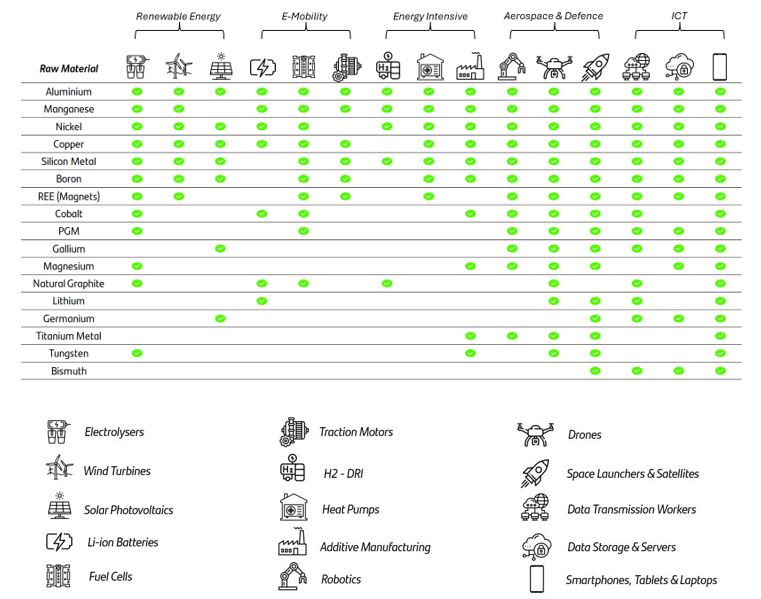
Below you can find a more detailed overview of raw materials’ importance across 15 key technologies. Selections have been based on:

  • Further expansion for energy and digital transformation 
  • Likely growth of emerging technologies
  • Relevance to EU security
A table showing the importance of a number of key raw materials


European Critical Raw Materials Act 

Considering the aforementioned importance of so many raw materials, one must examine how legislation aims to maintain resiliency and diversification, particularly with reserves of so many spread far across the planet. 

A good case study for this is the European Critical Raw Materials Act, which was provisionally agreed in November 2023, aiming to increase and diversify raw materials supply, strengthen circularity and support research and innovation on resource efficiency.

Within the Act comes a number of benchmarks, in order to establish rules for the environmental footprint of critical raw materials, as well as their sourcing, along the value chain and for diversification of EU supplies by 2030:

  • At least 10% of the EU’s annual consumption for extraction 
  • At least 40% of the EU’s annual consumption for processing 
  • At least 25% of the EU’s annual consumption for recycling
  • No more than 65% of the EU’s annual consumption from a single third country 

Global policymaking and the role of climate projects on raw material supply 

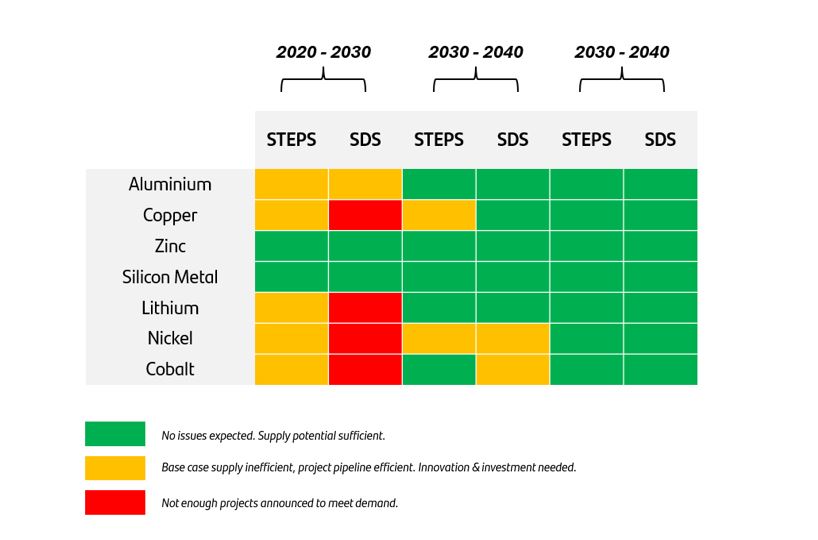
With the deployment of renewable energy technologies comes the expectant result of strong demand pull for several key resources. This demand could be hard to meet with the available primary and secondary supply – the latter being derived from recycling resources. 

See how supplies are shaping up over the next couple of decades across two distinct policy outlooks, as per KU Leuven:

  1. Stated Policies Scenario (STEPS)
  2. Sustainable Development Scenario (SDS)

This expected scarcity of supply could lead to increased commodity prices. 

Actions to reduce metal demand could also be deployed, such as technological innovation and substitution to reduce and optimise metal intensities in existing clean energy technologies, among others.

KU Leuven research
Image

Cyber security: corporate treasury’s unique leadership role in cyber resilience

Corporate treasurers have an important and unique leadership role to play in building cyber resilience as the centre of expertise for risk management and balance sheet strength, as well as being the custodian of sensitive data related to payments.

Looking at the preparation and incident response trends of recent years, what can the treasurer do differently?

Managing up

The first thing that a treasurer can do is lobby to ensure that cyber security is part of the Audit and Risk Committee’s agenda as much as liquidity, credit or market risk. As it is impossible to totally prevent a security incident, cyber security cannot be a “one and done” and is instead better maintained as a standing item.

Embedding such ongoing strategic governance will not just set the tone that cyber resilience matters but also ensures a common understanding of what this refers to: cyber security is the way in which we reduce the risk of a cyber-attack and ensure that our organisation is protected.

Secondly, one must understand where and how cyber risk has been managed to date. A word of warning, this could well uncover a patchwork. For example, there could be mixtures of individual business units managing this for each of their operations, the General Counsel’s office as part of the adoption of GDPR, and the organisation’s Chief Information Security Officer (CISO) from a systems lens. 

Only by understanding this landscape of responsibility and accountability can the treasurer embed resilience.

Managing from within

The treasury and wider finance division need to have sufficient understanding to constructively engage on cyber resilience and response.

This can be achieved through a team whiteboarding session. Opening the floor to facilitate a self-assessment of processes owned by, as well as those adjacent to, the treasury team will quickly, easily and cheaply uncover the current state of understanding and preparedness.

The cyber security pillars of Defend, Anticipate and Engage can be applied as a framework to facilitate this: 

Defend

It is important to proactively manage the treasury technology stack in addition to the processes in place from IT and the CISO’s office, such as email filtering. For example, are all systems or platforms owned by treasury patched, up to date and coming with a systematic approach to on/offboarding employees? If so, when did we last test this, or verify that principle of least privilege is in place?

Anticipate

The key to being prepared for a cyber incident is mastering the basics and aligning with existing treasury operational risk processes. Steps such as ensuring that your response plan is backed up in a logically or geographically separate way (a backup in the same location will almost certainly be targeted in an attack) - including the specific requirements of treasury is the best way to enhance resilience.

At a minimum, this should include internal (e.g. CISO and shared services partners) and external (cash management banks and lenders) contact details, as well as the criteria for triaging payments and reconciliation of the most important transactions in a contingency scenario.

Engage

People are and always will be the best form of cyber defence. While there are likely to be organisation-wide training programmes on identifying suspected phishing emails, for example, these will not reflect the nuance that each team culture will differ.

It is important to test if the treasury department has an environment which allocates blame or extracts learning. For example, if someone uncovered a way to circumvent a maker/checker functionality, would they feel comfortable to flag this to their manager?

Managing across

To adequately defend, anticipate and engage on an enterprise-wide basis, all parts of the organisation must act in unison. The steps above will help treasurers understand where the key partnerships will be.

This may see discussions with procurement if contracts do not include supplier resilience vetting, historic HR practices concerning revised payroll processes or cross-functional learning dialogue following a near-miss. 

This leadership is a critical tool in demonstrating corporate treasury’s continued strategic value to the organisation, and central role to enterprise risk management.

Santander Corporate & Investment Banking enhances the security of both our clients and society in the online world. As a financial institution, we are actively working on adopting the Digital Operational Resilience Act (DORA) and the revised Network and Information Systems Directive (NIS2) to build on our existing layers of security:

  • Protect: This includes tools with the primary function of preventing cyber-attacks (firewalls, antivirus, email filters, physical, hardware and software access control);
  • Detect: 24/7/365 monitoring to identify anomalous or malicious activity, including machine learning;
  • Respond: The investigation stage which could include deactivating systems or forensic investigation to prevent further infection, risk or recurrence.

In terms of enhancing resilience for our clients, as a pan-European and American leader in Cash Management, a vital component is providing a single access point for transaction processing via Santander Cash Nexus. This is an important source of operational risk reduction, by reducing the number of potential points of weakness.

We also challenge ourselves to find new ways to drive connectivity with our clients’ technology. 

Image

Santander CIB named global leader in export finance for second year running

The Group held on to the number one spot with a total volume of USD 13.2 billion and an international market share of 12.1%.

The bank’s global scale and local knowledge of the sectors and markets where its clients operate has enabled Santander CIB to stay ahead of its competitors in a year when transaction volumes soared.

Santander Corporate & Investment Banking (Santander CIB) ended 2023 as the world's leader in export finance, with transactions amounting to USD 13.2 billion (EUR €12 billion at current exchange rates) and a market share of 12.1%. 

Santander CIB's close relationship with all export credit agencies (ECAs) worldwide and its in-depth knowledge of the sectors and markets where its clients operate have ensured its position on top of the ranking published by Dealogic, one of the most widely used tools for analysing the performance, trends, activity and market share of financial institutions. 

With this positioning, the Group demonstrates once again its ability to meet its clients’ needs globally in a tough landscape. Santander CIB reached the first position in Europe and is among the top 10 in Latin America, the Middle East and Africa.

According to Guillermo Hombravella, global head of Export & Agency Finance: “In today's complex environment, large multinationals and medium-sized enterprises have trusted Santander CIB to support their international activity. Our vast experience gives us deep knowledge of our clients’ needs: we’ve built a unique global franchise that brings together sponsors, exporters, importers, ECAs and investors from all over the world. What’s more, our global footprint enables us to connect Europe, the Americas, Asia-Pacific, the Middle East and Africa which, in turn, allows us to offer an exclusive catalogue of financial solutions”.

Credit insurance from ECAs and other multilateral institutions is one of the main means of financial support for companies’ international expansion. It helps them obtain financing through specialised products with competitive terms and conditions that are tailored to their needs and mitigate the risks that their cross-border activities can pose.

In recent years, Santander CIB has been developing its Export & Agency Finance (EAF) business, with the spotlight on import and export clients. It has contributed to the design of innovative products hand in hand with ECAs, combining global and local origination and structuring capabilities that underpin the franchise's success.  

Image

WATCH: Financing the clean hydrogen sector

With corporates and governments committing to decarbonisation targets, the need for flexible and innovative financing solutions for green projects is becoming more relevant. 

Clean hydrogen is a potential player in this space. While the market is still in a somewhat embryonic state – particularly in terms of prices and demand – it has potential for decarbonisation, bolstering energy security and job creation. 

Speaking to World Hydrogen Leaders’ Nadim Chaudhry, Santander CIB’s Global Hydrogen Lead, Urbano Troncoso, dives into the challenges of being a financier to such ventures, while looking at the ins and outs of electrolysis platforms, and the regulatory landscape for clean hydrogen projects. 

You can watch the full interview below: 


At Santander we continue to work towards our net zero ambitions, having mobilized EUR 114.6bn of our EUR 120bn target for 2025 and we remain one of the world leaders in renewables financing.

Our award-winning Structured Finance team provides clients with strategic advice and access to a tailored suite of specialised financing solutions. Our expertise spans across a large range of industries, from Renewables and Power to Transport and TMT. Learn more here.  

Image

What are the key market trends impacting Working Capital?

The world of Working Capital can be a volatile one for corporates of all sizes to navigate, and with ever-more uncertainty on the macroeconomic and geopolitical stage, it’s imperative for these businesses to both stay on top of emerging trends in this space, and perhaps most importantly, find solutions.

The events that have defined the last three years have had a significant impact on global trade. In this blog, we review some of the major trends that are impacting global supply chains and Working Capital requirements. 

After a period of relative stability in 2023, characterised by limited raw materials and core component shortages and minor logistic issues, supply chain disruptions have once again come to the fore, driven by various factors such as extreme weather conditions and geopolitical tensions. 

Geopolitical tensions are expected to be a key factor in global trade in 2024, and there are increasing concerns about the long-term impacts of climate change on global supply chains.
 
Nearshoring has also gained considerable attention as a strategic choice for businesses seeking to optimise their supply chain operations.

Within this article we also look at changes in consumer behaviours, including the rising trend of ‘doing rather than having’ and the shift from traditional ownership-centric models to a subscription-based approach: Everything-as-a-Service

Bart Timmermans, European Head of Global Transaction Banking (GTB) at Santander CIB, said: “Despite all global disruptions and the impact on trade flows, Santander CIB continues to create new solutions to support our clients during the business transformations they go through. We have examples in all sectors, from automotives to batteries, or consumer goods to retail, in helping our clients to optimise their supply chains.”

Here are five key trends impacting Working Capital in 2024: 

Supply chain disruption is back 

Supply chain disruptions appeared to be fading in the rear-view mirror last year, as things returned to some form of normality following the pandemic – the cost of shipping, delays, availability of raw materials and other key indicators had returned to pre-pandemic levels. Now, in 2024, supply chain disruption is back to the top of the agenda, for a variety of reasons, including extreme weather events and geopolitical instability. 

The impact of geopolitical instability

Geopolitical instability has emerged as a critical factor significantly impacting the complex network of global supply chains. The Ukraine-Russia war first and the more recent Middle East conflict are having notable impacts on commercial trade.

Aside from the increase in oil & natural gas prices, and war risk insurance premiums, companies have been obliged to face higher costs and time to reroute cargos away from dangerous areas, thus continuing to add significant issues to supply chains.

Carriers have already diverted more than $200bn in trade from the Red Sea, adding about 6,000 miles to a typical journey from Asia to Europe and on average three or four weeks on product delivery times. 

The impact of weather 

Everstream Analytics’ annual risk outlook ranks extreme weather as the biggest threat to global supply chains in 2024. These extreme weather events are becoming increasingly common, placing further pressure on supply chains.

Floods, droughts, and other extreme weather conditions are becoming a recurrent issue both in Europe and the US, hammering ports, highways and factories on a global scale. 

Low water levels hitting shipping capacities – for example at the Panama Canal and Rhine River - violent storms disrupting automotive industries and heatwaves & droughts affecting European agriculture (namely Spanish olive production) are just some of the ways climate change is playing a part in this Working Capital headache. 

It’s true that supply chain disruptions caused by COVID-19 are largely a thing of the past, however, ensuring resilience levels remain high in order to counter the increasing threat of climate change should become a top priority, with options including diversifying source locations and investing in climate-resistant locations.

To ensure a better measurement of GHG emissions across the entire value chain, companies have started embedding sustainability criteria in their Working Capital solutions. Sustainability-Linked Supply Chain Finance, for example, represents one of the best-established WC solutions increasingly requested by companies to combine the typical financial benefits of SCF with scope 3 emissions reduction targets. 

Nearshoring – the trend of shortening supply chains  

After a period of turmoil, many companies are looking to shorten their supply chains to reduce reliance on foreign suppliers, in a bid to increase business resilience. 

In Europe, there has been a 29% increase in demand for industrial space, driven in large part by manufacturing and logistics – an example of this being Mercedes-Benz and BMW both announcing plans to open new production plants in Europe, as part of their long-term electrifying strategy, with lower labour, transportation and energy costs cited. 

While these decisions are often viewed, rightly, as bringing production closer to end-customers, nearshoring may also represent a key priority in a company’s sustainability agenda to reduce carbon emissions related to long-distance material transportation.  

The proximity to local markets, faster delivery times and improved responsiveness to customer demands will only see nearshoring usage increase in the years ahead. 

From a Working Capital Management standpoint, Supply Chain Finance (SCF) represents a core solution to support companies to engage with new suppliers and secure adequate payment terms to avoid increases in Working Capital requirements. Companies can leverage SCF to establish solid relationships with new suppliers, reduce procurement-related risks and potentially embed a sustainability-link, reducing scope 3 emissions.

From just-in-case to just-in-time 

Higher borrowing costs and inflation levels have led to many corporates investing resources in inventory reduction. 

It’s been reported by S&P that, since the end of 2022, global companies have been heavily reducing the quantity of inputs purchased, as well as stocks of raw materials and finished goods. In the S&P report, they noted how finished good purchasing had been on the downturn for 13 consecutive months, while finished good levels were cut for eight of the last nine months.

This has been mirrored on the production side to mitigate risks of maintaining high levels of finished goods.

The impact of this reduced consumer demand – and as a result destocking trend – has been noticeable. 

Within the chemical sector, many global players have reported notable losses, both in Europe and the US. 

The consumer industry has also, unsurprisingly, felt the strain of reduced demand, although this isn’t an all-encompassing problem, with some companies experiencing a share price uptick in the first quarter of their 2023 fiscal year, thanks a notable cut of inventories. 

From a financial perspective, the de-stocking trend is expected to have a notable impact on Days Inventory Outstanding (DIO) and, more broadly, on Working Capital requirements. The return to the just-in-time approach is helping companies to reduce the levels of inventory, both for raw materials and finished goods, and decrease the time of goods on the shelf.

“Doing rather than having” – where do consumers’ priorities lie?

One major shift in consumer behaviour since the pandemic has come in the shape of prioritising experiences over material goods, characterised by high inflation and rising interest rates. 

The events industry, for instance, has seen significant growth over the last few years, and this is forecast to continue over the next few years, becoming a $2.1tn industry by 2032.

Look too at industries selling experiences – travel, leisure, entertainment – who have benefitted from a 25% rise in sales in 1Q2023. From a Working Capital perspective, companies operating in these sectors have experienced a notable increase in sales, with a consequent 10 day reduction of Cash Conversion Cycle over the last two years, mainly driven by a reduction in Days Sales Outstanding (DSO). 

Conversely, several other industries are now reporting a more negative outlook thanks to consumers cutting back on certain types of discretionary spending; the purchase of food and beverages has declined by approximately 5% since 1Q2021, with home cooking giving way to eating out in restaurants. With higher levels of unsold goods on the shelves, companies are increasingly exposed to report again higher inventory levels, increasing the importance of Working Capital management.

A shift from ownership-centric models to a subscription-based approach 

The concept of Everything as a Service (XaaS) has revolutionised the way businesses operate, representing a fundamental shift from traditional ownership-centric models to a more versatile subscription-based approach. 

Software as a Service (SaaS) or Equipment as a Service (EaaS) are established examples, although with more cutting-edge technology destined to emerge, this umbrella will only expand. 

The global XaaS market size was valued at approximately €550bn in 2022, yet is projected to reach a market value of €3tn by 2030.

The possibility of accessing strategic assets without balance sheet implications represents the main driver behind the growing demand for solutions. Moving from a Capex-intensive model to an Opex focused scheme - whereby companies will not be requested to immobilise significant amounts of resources on a single asset - can maintain access to core production facilities without impacting financial and working capital ratios.   

Beyond the financial benefits, XaaS is also helping companies re-adjust their operating models by improving their agility, so they can adapt their business to evolving market dynamics quickly and scale operations seamlessly.  

Image

Seven key considerations for Cash Management in 2024

Going into 2024, the treasury landscape looks set to be etched against a backdrop of challenges once again. Global uncertainty, alongside higher commodity prices, inflation, and interest rates will undoubtedly be top of mind for corporates when considering supply chain impacts and how that may translate onto the balance sheet. 

Almost four years on from the onset of the pandemic, as higher manufacturing and borrowing costs mount, sustained pressure on firms to stay profitable may lead to an increased focus on squeezing costs across the value chain. 

Forward-thinking cashflow forecasting, coupled with a joined-up global liquidity management approach will be key. Overall, a Cash Management strategy that is embedded in simplification and innovation, whilst nimble enough to respond to change at pace, will be vital. 

Below we set out our seven key considerations for effective Cash Management for corporates in 2024:

1. Investing in a solid technology stack as a long-term play

Although focus on costs is likely to be central for firms, prudent investments today in modernising technology across the fundamentals like payments processing, API connectivity or a robust ERP can prove a strategic long-term play.

Additionally, rationalisation of operations across shared service centres and sales and distribution units will be key to prime for sustained growth.

2. Unlocking the value of location strategy 

This can be done by re-examining where trapped cash may be less optimised in countries with legal and regulatory barriers, and reviewing trade and working capital programmes to ensure they continue to be commercially attractive could reap benefits.

3. Considering the breadth and depth of solutioning 

This is of particular importance when thinking about near and medium-term strategic goals, as this is integral in driving efficiencies in Treasury processes. Whether that is in embarking on a transformative project like re-imagining an in-house bank, accelerating adoption of real-time payments, or promoting APIs as central to connectivity, assessing all available options to cater to specific business models will be advantageous.


4. Giving credence to the global-local dichotomy

Opting for homogenised solutions oftentimes makes perfect commercial sense, however taking the time to carefully assess and acknowledge specific country or operational nuances will be critical to building an elastic Treasury strategy to support business ambitions. 

For firms that find themselves with sizeable cash-rich positions, this could be in evaluating cash pooling and virtual account structures to ensure they are meaningful from the bottom-up and equally across global entity structures as well. 

5. Future-proofing investment strategy

Although the themes of ESG and green investing are by no means new to the agenda, there is increased traction in this space to seriously give consideration to this investment category which speaks to corporate values whilst delivering a diversified investment portfolio. 


6. Collaborating with partners that truly value the importance of platform reliability 

In an age where speed and agility are key but very much go hand-in-hand with cyber security, taking the time to choose the right collaborators is crucial. In an overcrowded marketplace, the choice in Cash Management providers has never been greater for corporates.

However, with cyber security increasingly a top priority for the C-suite, carefully assessing to onboard a partner that shares the same ethos and cyber risk management approach will be important. 

7. Getting the basics right consistently

Whether that is in efficiently processing payments and collections or ensuring deposit income is invested to provide the most optimum returns on security, liquidity, and yield, remaining laser focused on executing the basics to a high standard in BAU will continue to come first. 

Santander CIB’s Cash Management expertise 

During these times of unprecedented market change, Santander CIB is committed to helping our clients navigate the intersection of corporate treasury transformation, effective liquidity management, and technology innovation across industry sectors. 

With decades of experience spanning across Europe, Asia and the Americas, Santander’s Cash Management practitioners are trusted partners that truly understand what it means to differentiate. 

Drawing on the strengths of our global franchise and depth of our product propositions, cutting-edge technology capabilities and utilities, we roll-out complex and integrated Cash Management solutions that are centred around a best-in-class client experience: 

  • Flexible liquidity management solutions adjusted to your treasury management needs. Our frictionless solutions are designed to inform better business decision making, risk management and reconciliations, ultimately leading to sounder balance sheet management. 
  • Scalable end-to-end payments management, including a secure online banking platform powered by a cutting-edge global payments engine, and full-range of connectivities across payments rails from the ERP to the final beneficiary.
  • An integrated collections offering enabling you to optimise your sales conversion. Supporting all major international payment methods and schemes, our value proposition is designed to accelerate time to market and expand reach. 
  • Access to state-of-the-art technology platforms embedded in innovation, simplicity and flexibility. Our unique operating model affords us the reliability of a bank with the flexibility of a Fintech.
  • With strong risk, compliance, and fraud prevention processes, protecting your data and information is paramount to us. We are constantly evolving our technology and controls to bolster cybersecurity defences and operational resilience, putting the safety and security of our clients at the core of our operations.

Eva Bueno (global head of Cash Management), says: “We are fully committed to helping our clients grow their businesses through an advisory approach in the evolving payments ecosystem, spearheading innovation and co-creating solutions together.”