Image

The past, present and future of debt capital markets

Debt capital markets (DCM) are a key tool in the armoury of businesses looking to raise money through debt securities such as corporate bonds, but as with everything in the world of corporate and investment banking, the landscape is shifting beneath our feet. 

In 2022, the world’s total DCM issuance was $6.3tn, with the record to date being 2020, which was closer to $9.5tn. 

Not insignificant sums of money, but from where did debt capital markets originate, and in what direction do we expect them to go as we approach the second quarter of the 21st century? 

The history of debt capital markets 

You can go all the way back to 2400 BCE for the first recorded bonds – in existence long before stocks – which originated in modern-day Iraq and were written on clay tablets. 

However, it’s the 17th century where the idea of selling debt truly took off, as the Bank of England, one of the world’s oldest central banks, started issuing government bonds. Indeed, this also marks the birth of Gilt markets, courtesy of these particular certificates coming with gilded edges. 

Debt markets gained further traction in the 1700s, as a new covered bond known as the German Pfandbrief – a dual resource, asset-backed security – came into existence with noble landowners raising money against both their own credit and the value of their estates as a security. 

The next major revolution in the world of debt issuance came in July 1963, when the Autostrade issue for the Italian motorway network brought the first ‘Eurobond’ to the market, meaning that a multinational syndicate composed of financial institutions, for the first time, actively underwrote and distributed a transaction in a major currency – at the time, the US dollar. 

Since the 1960s, we have seen the market develop into a truly global animal. The present-day internal debt capital markets are comprised of bond dealer associations, clearinghouses, and exchanges, to name a few, while we’ve also seen the creation of single currencies and a multitude of investment banks, brokers, dealers and investors.  

Indeed, Santander CIB has a strong presence in many markets, acting as a structurer and underwriter of transactions, distributing paper across the globe and making secondary markets in a variety of subsets of asset classes that exist for Corporate, Financial Institution, Sovereign, Supranational and Agency clients. 

While Santander CIB’s place in the DCM ecosystem is a strong one, it’s never been more crucial to ensure fingers remain on the pulse of cutting-edge developments in the world of debt issuance. 

Have DCMs sufficiently modernised? 

Despite many advances in the trading of bonds in the secondary market over the years – such as the increase in the number of venues, as well as progressive automation – there has been surprisingly modest progress in the way new bond issues are executed, despite the significant technological steps made over the period. 

Right until the mid-90s, orderbooks were collated with pen and paper on trade blotters, and while spreadsheets sped matters up, the process overall was still an overwhelmingly manual one. 

Then along came online, shared order book systems, which brings things to the present day. This system allows salespeople, at all banks or institutions involved within the transaction, to enter orders into new issue order books once deals are announced. 

These systems also have the capability to automatically find and clean duplicate orders, while fixing any inconsistencies that arise, all but avoiding the need for long reconciliation calls, enabling more time to be spent on clients’ needs and less on timely administration. 

Conor Hennebry, global head of Corporate Debt at Santander CIB, comments: “our origination platform has grown considerably over recent years, and this is in part down to the investment in technology and our commitment to digital solutions.”

Santander’s place in the DCM ecosystem 

Santander CIB is committed to playing a key role in the in industry’s ongoing electronification, and accelerating the transition towards a more complete and coherent process, where investors can use their own, in-house order management systems to place orders and receive allocations. 

The deal execution world is complex and requires conjoined efforts from many of the key players in the DCM sphere, including Santander, in order to make the operation more efficient, particularly in relation to any pre- and post-launch processes such as pitching, provision of legal documents and settlements. 

Furthermore, Santander has been at the forefront of using blockchain for issuance, where in 2019 it launched the first end-to-end blockchain bond, worth $20 million. 

At the time, José M Linares, SEVP and Global head of Santander CIB said: “our clients are increasingly demanding the best thinking and technology in how we serve them in their capital-raising efforts. This blockchain-issued bond puts Santander at the forefront of capital markets innovation and demonstrates to clients that we are the best partner to support them on their digital journey.”

John Whelan, Managing Director – Crypto & Digital Assets at Santander CIB says: “the entire securities lifecycle has scope for digitization. At some point we can imagine where all securities will be digital and programmable. At Santander we are pleased to be playing our part with our clients in this extraordinarily complex industry transformation."

“It’s been a long time coming, but I truly believe we are about to experience huge advances in the efficiency of the full lifecycle of bond execution with the help of technology” adds Stuart Montgomerie, Managing Director – global head of Syndicate at Santander CIB. 

“We are passionate about playing our part to make this happen, working closely with our issuer and investor clients to ensure Santander is driving these changes for the benefit of all market participants as well as the global economy.”

Image

Santander CIB acquires stake in EIT InnoEnergy to accelerate and scale clean energy innovation

Santander CIB has taken part in a EUR 140 million investment round by EIT InnoEnergy, alongside other strategic investors.

The investment will help speed up innovation in clean energy by supporting InnoEnergy’s startups.

The move is part of Santander’s strategy to remain at the forefront of sustainable technology and renewable energy advisory and financing.

Santander Corporate & Investment Banking (Santander CIB), a world leader in renewable energy financing, today announces that it has acquired a stake in sustainable energy trailblazer EIT InnoEnergy as part of a EUR 140 million investment round alongside other strategic partners.

The move is part of Grupo Santander’s strategy to remain at the forefront of sustainable technology renewable energy advisory and financing. The funds raised will help grow the 200 companies that comprise EIT InnoEnergy’s portfolio, speed up the launch of new startups and boost the company’s expansion in the US.

Since signing a collaboration agreement with EIT InnoEnergy in April 2022, Santander CIB has supported several InnoEnergy startups. Amongst other, advising France’s biggest battery manufacturer, Verkor, on its partnership with Renault, and financing to Germany’s leading hydrogen power solutions company, HPS.

InnoEnergy currently has a portfolio of 200 companies, three of which are unicorns, on track to generate €110 billion in revenue and save 2.1G tonnes of CO2e accumulatively by 2030. Collectively, these companies have raised €9.7 billion in investment to date. This private placement round accelerates InnoEnergy’s role in turning Europe’s ambitions to reach its 2050 net zero objective into a reality, after being the first economy in the world to enshrine it in climate law.  

According to Lucas Arangüena, global head of Green Finance for Grupo Santander and global head of ESG for Santander CIB: “As a world leading advisor and financier in Climate Tech, this partnership enables Santander  to accelerate and de-risk the development of hundreds of EIT InnoEnergy portfolio companies as we have successfully done in the past, showing Santander’s commitment to contribute to the shift to a low-carbon economy and to achieving the Sustainable Development Goals. Addressing the energy transition, which affects all of our 164 million clients, demands innovation and technology at scale. Building on our successful year-and-a-half strategic partnership, we’re excited to have found a partner in EIT InnoEnergy that is at the cutting edge of technology and innovation, and that has the scale to make a real difference”.

Mikel Lasa, CEO of EIT InnoEnergy Iberia, said: “We’ve hit our investment targets this round. While new strategic partners have come on board, some have reinvested. Between them, we’ve raised enough funds to double our impact. InnoEnergy, its portfolio and its partners are in a unique position to ramp up the energy transition in Europe and, indeed, the world, not to mention reindustrialization in the West. We’re ready for what’s next. We embarked on our mission in 2010 and are making inroads every day”.

Commitment to sustainable energy

According to Infralogic, Santander remains the leader in renewable energy financing, with over EUR 5.161 billion mobilized across 78 deals, and a market share of 4.38%. The acquisition of an 80% stake in WayCarbon Soluções Ambientais e Projetos de Carbono, a Brazil-based leader in ESG consultancy, is helping Santander CIB grow its product portfolio and develop proprietary carbon projects. Grupo Santander has pinpointed six trends crucial to the transition to net zero: hydrogen, batteries, carbon capture and storage, biofuels and circular economy, clean mobility and food tech.

The Group has pledged to mobilize EUR 220 billion in green finance between 2019 and 2030. As of June 2023, Santander CIB had already raised and mobilized EUR 98.6 billion.

In 2022, Santander Asset Management (Santander AM) and EIT InnoEnergy launched the Santander InnoEnergy Climate Fund, an investment vehicle giving private banking clients and institutional investors access to a portfolio of companies in the circular economy, renewable energy, energy storage and efficiency, transport and mobility, smart buildings and cities, energy distribution networks, and hydrogen.

Santander Corporate & Investment Banking (Santander CIB) is Santander’s global division that supports corporate and institutional clients, offering tailored services and value-added wholesale products suited to their complexity and sophistication, as well as to responsible banking standards that help our communities prosper.

PR

Santander CIB partners with Komgo through an equity investment to digitalize trade finance

Santander CIB invests in leading trade finance fintech Komgo to help large multinationals boost digitalization.

The global partnership will accelerate the digital transformation of trade finance.

Santander Corporate & Investment Banking (Santander CIB), one of the leading global banks in trade finance, and Komgo, the world’s largest multi-bank trade finance network, have partnered to accelerate the digital transformation of several Trade & Working Capital products. 

Santander CIB has become a shareholder of Komgo with a strategic equity investment. Both companies expect to build up synergy between Komgo’s cutting-edge technology and corporate client base, and Santander CIB’s unique global footprint and leadership in trade finance.

According to Mencia Bobo, global head of Trade & Working Capital Solutions at Santander CIB: "We want to support our clients simplify and digitalize trade finance. Partnering with Komgo means we can automate communications, optimize end-to-end processes, reduce operational risk and deliver the best client experience. In addition, it will enable us to innovate and find synergy in our broad Trade Finance business.”

Souleïma Baddi, CEO of Komgo added: “Komgo is the preferred trade finance network for the industry’s largest banks, and delivers the best experience to corporate users in their workflow management. As a leading financial institution and one of the largest trade banks globally, Santander CIB’s investment in Komgo adds another layer of trust to our network. We are especially proud to be supporting its clients’ transformation journey.”

Komgo will further strengthen its market leadership by expanding its trade finance proposition after having acquired Global Trade Corporation (GTC) last year. Santander CIB will contribute expertise and tailor-made Trade & Working Capital solutions for Komgo’s client portfolios in Europe and the Americas, while benefitting from Komgo’s technology to improve client-to-bank communication and to deploy innovative solutions in trade finance and commodities.

Banco Santander (SAN SM, STD US, BNC LN) is a leading commercial bank, founded in 1857 and headquartered in Spain. It has a meaningful presence in 10 core markets in the Europe, North America and South America regions, and is one of the largest banks in the world by market capitalization. Santander aims to be the best open financial services platform providing services to individuals, SMEs, corporates, financial institutions and governments. The bank’s purpose is to help people and businesses prosper in a simple, personal and fair way. Santander is building a more responsible bank and has made a number of commitments to support this objective, including raising €220 billion in green financing between 2019 and 2030. In the first quarter of 2023, Banco Santander had €1.2 trillion in total funds, 161 million customers, 9,000 branches and 210,000 employees.

Santander Corporate & Investment Banking (Santander CIB) is Santander’s global division that supports corporate and institutional clients, offering tailored services and value-added wholesale products suited to their complexity and sophistication, as well as to responsible banking standards that contribute to the progress of society.

Komgo is the leading software development and technology services company transforming the trade finance industry. Our innovative solutions empower Treasury, Credit, and Trade Finance teams, streamlining communications and strengthening operational capacity for over 10,000 enterprise users worldwide. From our Swiss roots we’ve expanded to key international locations including Singapore, Paris, London, Toronto and Houston, where we’re trusted by a diverse customer base which includes more than 200 multinational corporations and global trade banks. Together we’re building a trusted, transparent, and automated global trade execution environment, where financing is quick and easily accessible. Approximately USD1bn in transaction value flows through the Komgo Network each day.

Connectivity

How the presence of non-banking players in the payment space is making invisible banking a reality

A paradigm shift has been under way in the Cash Management business for some time now. Where once there was a bilateral relationship between the bank and the client, this is now a multilateral business where third parties participate to improve the overall service experience. In this context, Santander is analysing how to collaborate with new participants.

Before discussing SAP Ready, our solution for navigating this paradigm shift, it is important to describe the baseline situation. As a global bank, it is crucial for us to be at the forefront so as to continue offering a best-in-class service to our customers.

To make this possible and advance on a firm footing on this journey towards ‘invisible banking’, we explored what the market would want to simplify and facilitate their cash business. Here is where SAP Ready was born. SAP is the most widely used ERP among corporate clients, and it is the perfect partner to co-create distinctive solutions and make ‘invisible banking’ tangible.

Our alliance with SAP seeks to accelerate the digitalization of Global Transaction Banking services for our clients while helping them navigate supply chain disruptions and accelerate their decarbonization endeavours. SAP Ready’s ambition is to embed Santander Cash Management solutions, both global and local, within the client’s core system, enabling them to transact directly inside their own SAP ERP. It is important to highlight that SAP Ready is not only about Cash Management — it also covers the full scope of GTB solutions to enhance cash flow and lend efficiency to our clients’ supply chain using the most innovative solutions.

Jose Luis Calderon, head of Global Transaction Banking (GTB) at Santander CIB, said: “This partnership is a step forward in the digitalization of the solutions we provide to our clients, with a strong focus on connectivity, supply chain management and the energy transition. We already have a strong transactional banking solutions portfolio in Europe, America and Asia that helps our clients navigate the complexity of doing business globally. This value proposition comes from the combination of understanding their needs and their daily challenges while leveraging the latest technology that SAP can deliver and the depth and breadth of our product offering.”

In the Cash Management area, our vision is focused on three main pillars:

  • Connectivity: As we have announced on previous occasions, we continue working on the SAP Multi-Bank Connectivity (MBC) solution. This service connects banks and financial institutions to corporates across Santander’s footprint in a plug&play mode to resolve many issues that corporate treasurers face in their day-to-day operations by embedding banking services within corporates’ ERP systems.
  • Interoperability: We seek to offer cutting-edge technology in order to simplify and accelerate integration with our clients without requiring additional SAP installations. In this regard, Santander has been working on several initiatives to facilitate and accelerate our clients’ go-to-market processes and to boost their customer data extraction and transformation.
  • Evolution: This partnership is up and running, and the pace of initiatives to facilitate our clients’ operations will accelerate in the near future.

While the potential upsides of these projects for corporates are clear, the ability to quickly switch the banking provider could be seen as a threat, as it was thought in the past that a cumbersome process created ‘stickiness’, i.e., that customers would remain with their incumbent banking relationship because changing was too problematic.

However, this old-school mindset has changed over the past 18-24 months, fostered by the advent of cloud and application programming interfaces, as well as the rise of platform business models. Corporate banks now want to make it as simple as possible for customers to use their banking services by taking advantage of embedded finance solutions. For that reason, Santander is approaching not just ERPs but also TMSs and Bank Connectivity Providers, as their rise exemplifies corporates’ need for quick and easy-to-use solutions.

PR

Santander, world leader in export finance in 2022

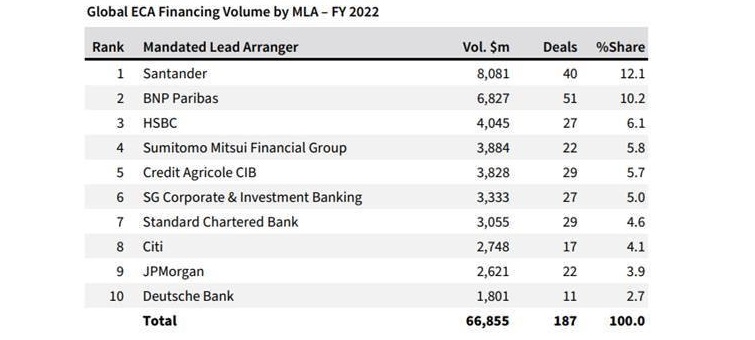
The Group topped the ranking with 40 transactions amounting to $8.081 billion, giving it an international market share of 12.1%.

The Bank's global capabilities, combined with local knowledge of all the sectors and markets where its clients operate, has enabled Santander to get ahead of the competition in a year marked by a significant increase in the volume of transactions.

Madrid, 25 January 2023.
Santander Corporate & Investment Banking (Santander CIB) ended 2022 as the global leader in export finance, with transactions amounting to $8.081 billion (€7.445 billion at current exchange rates), and a market share of 12.1%. Over the last financial year, Santander participated in 40 international transactions offering financing, through Export Credit Agencies (ECA) to support the international activity of medium-sized businesses and large multinationals.

Santander CIB has a strong relationship with all ECAs worldwide, which, as well as its in-depth knowledge of the markets and industries where its clients operate, has enabled the bank to top the list published by Dealogic, one of the most widely used tools for analysing the performance, trends, activity and market share of financial institutions in this market.

The macroeconomic and geopolitical context last year favoured greater market dynamism in regions such as the Middle East, Africa and Asia where Santander, together with its global customer base, was able to lead the market at regional level, in addition to its global leadership position.

José Luis Calderón, global head of Global Transaction Banking (GTB) at Santander CIB, said: ‘We are extremely happy to see Santander playing such a key role in this industry. We have been relentlessly investing in the business for the last two decades, getting closer to our clients, connecting sponsors, exporters, importers, ECAs and investors worldwide and innovating with the development of new products and structures with the main ECAs. We have been able to connect EMEA, the Americas and APAC to maximize our capacity to deliver the financial solutions our clients expect, not only for the big multinational companies but for mid-size enterprises as well.” 

Credit insurance from ECAs and other multilateral institutions is one of the main public financial support instruments for company internationalisation, helping companies to obtain financing on competitive terms with specialised products tailored to their needs and mitigating the risks associated with cross-border activity. Last year saw strong activity from European agencies such as Euler Hermes (Germany) and UKEF (UK), as well as Asian agencies with Kexim (South Korea) playing a prominent role.

In recent years, Santander CIB has been developing its Export & Agency Finance (EAF) business focusing on import and export customers. As such, it has designed innovative products hand in hand with ECAs, with a combination of global and local origin and structuring capabilities which are the basis of the franchise's success.

Guillermo Hombravella, global head of Export & Agency Finance, said: "Obtaining results like this and leading global rankings in the export finance business is made possible thanks to our relationship with our customers, our ability to understand their needs and the profound knowledge of ECAs and their products that the team has on a global level." 
 

Chart


PR

How are digital currencies impacting the payments game

Trending topics such as Cryptocurrencies, Stablecoins, DLT, Blockchain or CBDCs are part of many conversations in our daily life. Exciting times in banking may be coming since new shapes of money mean new ways of payments.  

Undoubtedly, banking industry must realize all these technological disruptions which may impact our client business in the upcoming years.

The core of these discussions within the industry lies on whether the new types of Digital Money would be valid means of payments. Santander Global Cash Management is no stranger to this subject.
 
Therefore the starting point is to understand the different sorts of Digital Money, what their attributes and specificities are and whether they could be suitable for transactional purposes. In a previous blog on stablecoins and CBDCs, we presented some of the varieties of digital currencies but there is more to know about these. In general terms, the industry sees it as a five-player game:

  • Commercial Bank Money: Nowadays worldwide predominant payment method, is the money that everyone has on their bank accounts. Although challenged and questioned, the industry is moving forward to deliver a much more efficient and seamless payment user experience (ISO20022 migration, instant payment schemes, APIs). 
  • E-money: Electronic Money is a type of digital money stored in -Money Institutions (EMIs)/Payment Institions (PIs) electronic wallets. While the industry hype is on Crypto and Stablecoins, e-money is increasing its popularity and user base (Mercado Pago, Mpesa, WeChat, Paypal). If the Closed loop nature of the solution brings instant settlement among parts and outstanding user experience, the reachability is exclusively bounded to the e-money network.
  • Central Bank Digital Currency (CBDC): CBDCs are a digital form of central bank money, just as banknotes and coins issued by Central Banks but digital. Most central banks are exploring their potential benefits and risks as well as the value-added for the payment systems. CBDCs might have a major case in developing economies where financial inclusion is still fairly low (e.g. e-yuan, Sand Dollar, or e-Naira). Meanwhile, in developed economies there is no clear answer yet to the question “Are there proven benefits for a CBDC?”. At the same time concerns have been raised on how CBDCs could impact financial stability, new infrastructure costs for the whole industry, anti-money laundering plus privacy implications, and cross-border spillovers.
  • Cryptocurrency: Digital asset that uses cryptography to secure transactions exchanged on a P2P network. Programmability, proven DLT network security, and disintermediation are key advantages delivered by cryptos. However, due to the ongoing turbulences in the global economy, the lack of regulation, and the increased volatility, cryptos are currently being seen more as intangible investment asset than a mean of payment. (Bitcoin, Ethereum…)
  • Stablecoins: Digital asset that seeks to deliver the benefits of cryptocurrencies while trying to remove their volatility. Some stablecoin (e.g. USDC) look a lot like a programmable form of e-money, combining the benefits of that ecosystem with the open source nature of DLT, leading the relatively new phenomenon of "decentralized finance" aka defi.

However, stablecoins have been making a lot of buzz recently showcasing the inherited risks these assets have.

Both risk and volatility shown by cryptos and stablecoins could be mitigated by regulation. In this regard, MiCA regulation in the EU is being created to provide a uniform legal framework for crypto-assets and similar efforts are under way in the US or UK.

Santander participates in several initiatives towards trying to analyze potential use cases where these new elements might be beneficial:

  • Fnality: Santander is a founder of the banking consortium to create a payment solution based on distributed ledger technology (DLT) and blockchain technology. It was created to facilitate peer to peer tokenized transactions backed by money held in a central bank account.
  • CBDCs: Santander is actively participating in the ECB consultation process and other initiatives launched by the central banks in those geographies where we are present, exploring potential use cases, benefits or technologies in which the potential CBCD would rely on.
  • Agrotoken: is the first global experience, launched in Santander Argentina, collateralizing loans with tokens based on agro-commodities such as soya beans, corn and wheat. The solution allows farmers to access new financing solutions extending credit capacity with tokenized assets.

“The Santander Cash management team is closely monitoring these new trends and initiatives to understand where the transactional processes could be impacted. More and more clients are seeking for comfort advice and solutions that ensure trust, reachability and interoperability and this can only be achieve through “Global Industry initiatives” (Fnality, RLN). Stéphanie Rodriguez Aniorté | Global Head of Payments Santander CIB

Technology disruption is changing the payment´s landscape… but the “final products” are yet to be revealed.

San Env

Banco Santander partners with Envision Group to accelerate net zero transition

Today Banco Santander announced a partnership with the companies of Envision Group, a global clean technology leader, to jointly promote the reduction of greenhouse gas emissions, leveraging the strength and expertise of both, to accelerate the global transition to a net zero economy.


As part of this agreement, Banco Santander, through the provision of commercial, corporate and investment banking services, will support Envision Group’s strategic projects globally, including the development of net zero industrial parks in Spain and worldwide, covering the battery Gigafactory of Envision AESC, renewable generation and storage system, green hydrogen generation plant, and other leading industries.

In addition, Banco Santander will collaborate with Envision Digital, the net-zero and Artificial Intelligence of Things (AIoT) Tech unit, to explore the application of its Net Zero technology to Santander’s customers to drive energy transition across industries and reduce Santander’s overall financed emissions. Envision Digital will also partner with Santander to monitor and further improve the energy efficiency of the Santander Group Headquarter, which is already carbon neutral since 2020.

José Antonio Álvarez, CEO of Santander Group said: “The partnership with Envision is a great example how cross-industry cooperation could generate synergies that will allow us to further support our clients and communities in the transition towards a net-zero economy and help people and businesses prosper in a sustainable way.”

As a global net-zero technology partner, Envision aims to solve the challenges for a sustainable future“, said Lei Zhang, founder and CEO of the Envision Group companies. “Banco Santander’s vision for reducing carbon emissions, not only in Spain but throughout its global portfolio, is truly inspiring. Together with Banco Santander, we can help companies across industries move faster towards a net-zero future.

Cyber

Cybersecurity's key role in investment banking

Over the last few decades, cybersecurity has evolved into one of the most critical functions globally, on both a corporate and governmental level. That’s no different at Santander CIB, where the cybersecurity team is headed up by David Sheridan, who has been at Santander for over 22 years and has overseen a huge amount of change. We sat down with him to explore how the world of cybersecurity has changed during his tenure, and what his team’s role at the bank is.

David explains that the function of cybersecurity at an industry level has evolved significantly  “Information security had largely been an IT function since the beginning of the interconnected age”, he says, “covering things like network security and systems access, it was very much a technical discipline within IT. Now, as people become more aware of the risks to businesses and clients from cyber threats and those threats become more sophisticated, it’s now treated as a discipline of its own”. 

Cybersecurity has come a long way in recent years. When the technology and platforms most companies use were originally built, they never imagined that the internet age meant the security of a product could change over time. In practical terms, that means that cybersecurity teams work with systems, which naturally overtime have vulnerabilities that have to be addressed. 

Our cybersecurity team plays a critical role within the bank, and their extensive remit covers both internal systems, and also working with suppliers and clients in an advisory capacity. 

Within the bank, the focus is on protecting, detecting and managing  before they arise. Ultimately, David explains, “this is a broader resilience piece. A lot of my team’s time is spent ascertaining whether we have the right controls to protect against  ransomware, testing systems for security or working with staff to understand the behaviors needed to protect against cyber threats. 

The work we do on staff training and awareness, and in ‘security by design’ in any new product or system we implement, is ultimately designed to defend what David describes as “the hyperconnected bank of the future” and implementing controls that ensure people can only access the information they need to do their jobs. 

Another area of focus is on supply chain risk. We therefore work closely with all our suppliers to ensure they are equally well protected and that they meet our security standards. “This all feeds into our client relationships as well”, David explained. As a business, it’s essential that we are secure right the way through our supply chain, to make sure in turn that our clients data and assets are protected. Ultimately, the job of the cyber security team when it comes to clients and customers is to generate trust between us, and value for them from our services. 
 

Germany

Tobias Heilmaier joins Santander as head of SCIB Germany

The appointment – effective 1st December - will further consolidate Santander CIB`s leadership position and its regional offering in Europe.

Madrid, 16 September 2022.

Santander Corporate and Investment Banking (Santander CIB) announces today that Tobias Heilmaier will join the bank to lead Santander CIB in Germany.

Santander CIB has an extensive international footprint across Europe and the Americas, with strong capabilities across a range of areas such as Corporate Finance, Structured Finance, Working Capital Solutions, Cash Management, Trade Finance, Syndicated Loans, DCM, and Market Risk Management. Santander CIB’s global sector focus on Energy, Infrastructure, TMT, Consumer Retail & Health, ESG, and Digital Solutions strengthens this geographical and global product approach.

Tobias has over 17 years experience in the financial sector. He joins Santander CIB from JP Morgan, where he was co-head of Investment Banking Germany and before that, co-head of Corporate Finance Coverage Germany. Prior to that, he worked at Goldman Sachs, where his last position was head of EMEA Chemicals as part of the Global Natural Resources team and where he was promoted to Managing Director in 2016.

His appointment will be effective 1st December. Tobias will report to Ignacio Dominguez-Adame, head of Santander CIB Continental Europe, and to Darren Jones, global head of Banking & Corporate Finance and Head of Santander CIB UK.

José M. Linares, global head of Santander CIB, said: “Germany is a very dynamic market, which plays a key role in our European capabilities. We are thrilled to welcome Tobias who will help us further strengthen our global franchise I am confident that his background and deep industry knowledge will support our growth ambition.”

PR

Mike Bagguley joins Santander CIB as head of Global Markets

Santander Corporate & Investment Bank (Santander CIB) announces today that Mike Bagguley has joined the bank to head its Global Markets business.

Mike spent most of his over 30-year career at Barclays, where he held multiple leadership roles within the markets business, leading macro products, trading for FX, commodities or options. He was also head of the Markets Business at ABSA Bank, where he was responsible for integrating and turning the business around following Barclays’ acquisition. Most recently, he was chief operating officer of Barclays International and Barclays Investment Bank, responsible for technology, operating platforms, risks and controls with a focus on improving commercial agility.

José M. Linares, global head of Santander CIB, said: “Our Global Markets business is a strategic pillar for Santander CIB and the group. This appointment will help us leverage our global capabilities and accelerate growth. I am confident Mike is the right person to bring our Global Markets business to the next level.”

The head of Global Markets position is a newly created role, bringing together the regional Markets businesses under a single leader. Santander’s Global Markets business offers risk management solutions, investment products and execution services to a wide range of clients, including corporates, financial institutions, financial sponsors and individuals.