Santander Latin American CEO Conference

Santander CIB marks 30 years of its Latin American CEO Conference in New York

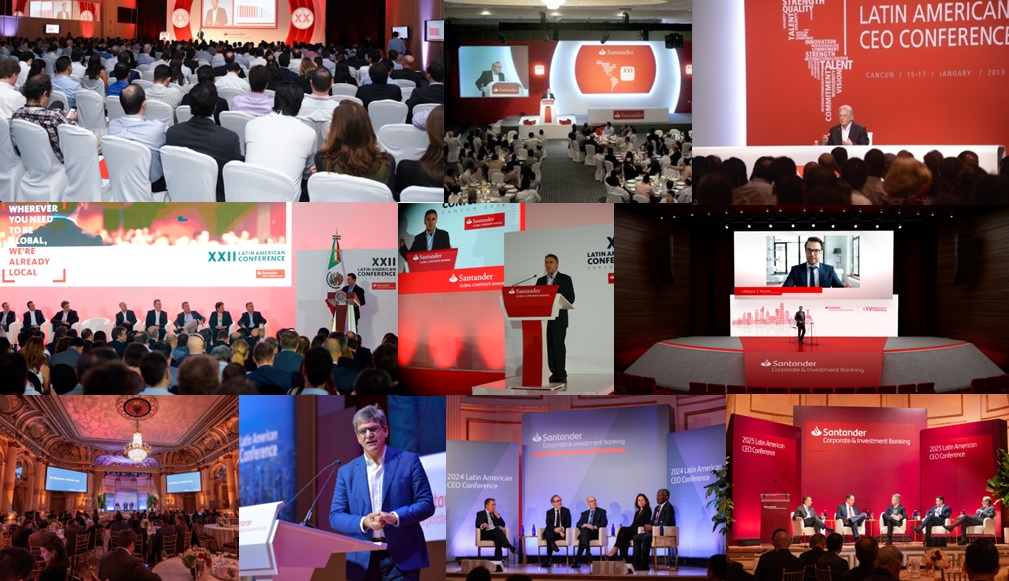
Santander Corporate & Investment Banking (Santander CIB) hosted the 2026 Latin American CEO Conference this week at The Plaza Hotel, marking the 30th anniversary of one of the region’s most respected corporate and investment banking forums.

Over three decades, the conference has established itself as a leading platform for dialogue between Latin American corporates, global investors and public sector representatives. This year’s edition brought together CEOs from across the region, institutional investors and senior policymakers to discuss the forces shaping Latin America’s economic outlook and long-term growth trajectory.
 

Image
Santander Latin American CEO Conference 2

The agenda featured in-depth discussions on geopolitics, monetary policy, corporate strategy and investment opportunities across key sectors. The programme included contributions from Ana Botín, Executive Chair of Banco Santander; Héctor Grisi, Chief Executive Officer of Banco Santander; and José M. Linares, global head of Santander CIB. High-level panels with central bank governors – including Julio Velarde, President of the Central Bank of Peru, and Santiago Bausili, Governor of the Central Bank of Argentina – political figures and policymakers – Maria Corina Machado, leader of the Venezuelan Democratic Movement and 2025 Nobel Prize Laureate, Antony J. Blinken, 71st US Secretary of State, and 48th US Vice President Mike Pence – and corporate leaders – such as Michel Doukeris, CEO of Anheuser-Busch InBev, and Horacio Daniel Marín, CEO of YPF – provided additional perspectives on the evolving macroeconomic and financial landscape. 
 

Alongside the main sessions, and a conversation between José M. Linares and Rafa Nadal that went far beyond sport, the conference facilitated a broad programme of one-on-one meetings between corporate leaders and investors, reinforcing its role as a catalyst for meaningful dialogue, capital formation and long-term partnerships.
 

Thirty years since its inception, the Latin American CEO Conference continues to reflect Santander CIB’s commitment to connecting markets, industries and regions. By fostering informed discussion and facilitating strategic relationships, the conference underscores Santander’s long-standing support for Latin America’s development and its next chapter of growth.

Santander Latin American CEO Conference 2026
Imagen

Santander CEO Latam Conference: 30 years connecting global capital with regional growth


For three decades, the Santander Latin American CEO Conference has been a premier meeting point for global investors and one of the world’s most dynamic economic regions. What began as a forum as an investor forum has evolved into a flagship platform where CEOs, policymakers and financial leaders shape conversation on Latin America’s economic future.

The upcoming 30th edition marks a defining milestone, reflecting both the conference’s growth and Latin America’s deeper integration into global capital markets. Over the years, the event has mirrored shifts in investment flows, geopolitical dynamics and economic transformation across the region.

From investor forum to strategic investment platform

Since its early editions, the conference connected Latin America’s leading corporates with international institutional investors and decision-makers. By convening senior executives from leading companies, global asset managers and industry specialists, it has consistently fostered high-level dialogue on growth opportunities, market risks and long-term value creation.

Attendance has expanded significantly, with recent editions bringing together hundreds of participants, including top management from the region’s largest companies and major global investment firms. This growth reinforces its position as one of the leading Latin America investor conferences worldwide. 

As the region navigated commodity cycles, political transitions, financial volatility and the pandemic, the agenda evolved to address sustainability, digital transformation, structural reform and resilient growth, underscoring Latin America’s enduring investment potential.

Addressing geopolitics, technology and capital allocation

The 2026 agenda reflect today’s priorities: geopolitics, technological disruption, market infrastructure and global capital allocation trends. Discussions now extend beyond macroeconomic outlooks to explore how global shifts in trade, finance and regulation impact Latin America.

Panels featuring finance ministers, central bank governors, CEOs and global policymakers highlight the conference’s unique positioning at the intersection of public policy and private investment.

One-to-one meetings remain a defining feature, enabling direct engagement between corporates and global investors, strengthening relationships and facilitating strategic transactions that often extend beyond the event itself.

New York: A bridge between regions

Hosting the conference in New York reinforces its role as a bridge between Latin America and international capital markets. The city provides a natural platform where regional insight meets global liquidity, supporting cross-border investment and strategic dialogue.

The presence of senior business and policy leaders also underscores the importance of collaborative solutions to shared challenges, including infrastructure financing, energy transition and technological innovation.

Shaping the next chapter of Latin America’s growth

The 30th edition is more than an anniversary. It reaffirms the conference’s core mission: strengthening investor confidence, fostering dialogue and supporting sustainable economic growth across Latin America.

As global markets enter an era defined by technological acceleration, geopolitical realignment and shifting growth patterns, the Santander Latin American CEO Conference remains a trusted platform where leadership, capital and opportunity converge.

Thirty years on, the commitment endures: connecting global investors with Latin America’s next phase of growth.


Imagen

The General Shareholders’ Meeting: more than a date in the calendar

Video file

For listed companies, the general shareholders’ meeting is often described as a formal requirement — a statutory milestone in the corporate calendar.

In practice, it is much more than that.

It is one of the few moments each year when the company, its board and its shareholders meet in a structured and transparent forum. It is where strategy, governance, performance and remuneration are placed under direct scrutiny. It is also where preparation — sometimes invisible from the outside — becomes critical.

Behind every meeting lies a process that begins months in advance. Agendas are shaped carefully. Resolutions are drafted and refined. Shareholder feedback is analysed. Voting trends are monitored. Internal stakeholders — from legal to finance to communications — must move in alignment. Increasingly, proxy advisors and governance expectations add another layer of complexity.

For investor relations and corporate teams, this preparation requires both technical precision and judgement. Each year brings its own context: evolving regulation, changing shareholder priorities, market sensitivities or company-specific developments. No two meetings are exactly alike.

Experience plays an important role in navigating this process. Having visibility on how voting dynamics evolve, where engagement may be required early, or which aspects tend to generate questions allows teams to anticipate rather than react. Small adjustments made months before the meeting can meaningfully influence how the day itself unfolds.

For more than 20 years, Santander CIB has worked alongside issuers — primarily in Spain — supporting them throughout this cycle. Our perspective is shaped not only by advising companies, but also by being a listed institution ourselves. That dual vantage point informs the way we approach preparation, coordination and execution.

Ultimately, a shareholders’ meeting is not defined by the duration of the event itself, but by the quality of the work that precedes it. When preparation is rigorous and aligned, the meeting becomes what it is meant to be: a clear, orderly and constructive dialogue with shareholders.

Imagen

Structured finance in a new global investment cycle

Large-scale infrastructure and energy projects are entering a renewed phase of global expansion. The acceleration of the energy transition, the growing demand for digital infrastructure and persistent investment gaps across developed and emerging markets are reshaping the project finance landscape. In this context, structured finance has become a strategic lever for mobilising capital, allocating risk efficiently and enabling complex projects to reach execution.

An article published in Expansion on 13 February 2026 highlighted Santander Corporate & Investment Banking’s (Santander CIB) position at the forefront of this market. Drawing on Infralogic data, the publication reported that Santander ranked number one globally in 2025 both as financial adviser and as lender in structured finance transactions, marking the strongest year in the bank’s history in this segment.

Acting as financial adviser in project finance requires designing robust structures, aligning sponsors and lenders, and ensuring that transactions withstand scrutiny from multiple credit committees across jurisdictions. As Benoît Felix, global head of Structured Finance at Santander CIB, explains: “Our first place in the financial advisers’ ranking demonstrates the change in model the bank is pursuing. Acting as adviser does not guarantee that the bank will also act as lender, although this happens in many transactions. Our objective is to find the best structure and the best transaction for the client.”

Building a global structured finance platform

Santander’s trajectory in structured finance spans more than 25 years, beginning with early renewable energy project financings in Europe and evolving into a global platform covering infrastructure, energy, digital assets and real estate.

Today, the team comprises more than 200 specialists across 15 countries in Europe, the Americas and Asia, with strong hubs in Spain, the United Kingdom, the US and Brazil. This footprint combines local client proximity with global sector expertise.

As Felix notes: “We have a competitive advantage through the combination of our global sector expertise and local presence. Some banks execute Latin American transactions from abroad. We have specialised teams in each country who understand the local market, supported by sector experts from New York, São Paulo, London or Madrid.”

Advisory strength and balance sheet commitment

In 2025, Santander advised on 67 structured finance transactions with an attributed volume approaching €30.6 billion. At the same time, it committed €24.1 billion as lender, leading global rankings on both fronts.

 This dual role reinforces credibility with infrastructure developers, energy sponsors and institutional investors. The structured finance platform is organised into five verticals, covering mega-infrastructure projects, renewable energy, selected data centre financings, real estate and structured credit solutions for funds and corporates.

Importantly, structuring discipline remains central. “In our team we look for professionals who stay grounded, who do not propose financing structures that the credit committees of financing banks will ultimately reject,” explains Felix. In a market where execution risk can delay or derail projects, pragmatic and realistic structuring is as critical as financial innovation.

Strategic focus on the United States and beyond

The Expansion coverage also underscored Santander’s progress in the United States, where the bank rose to second place in both advisory and lending rankings in 2025, up from sixth position the previous year. Renewable energy transactions played a significant role in this expansion.

We have focused on the US and delivered results,” Felix states. The US market remains a strategic priority for 2026, alongside continued development in Latin America, Europe and Asia, where the bank has reinforced its presence with teams in Singapore and Hong Kong.

Positioning for the next phase of investment

Looking ahead, the outlook for structured finance remains underpinned by structural drivers. Infrastructure deficits remain significant, decarbonisation targets demand sustained investment and digital transformation continues to generate new asset classes requiring specialised financing frameworks.

Felix highlights the long-term nature of the opportunity: “There is enormous potential in infrastructure worldwide. We are entering a new international investment cycle because there is still a gap to close, and it is very important for the bank to be there with our clients, innovating alongside them.”

As the global investment cycle evolves, structured finance will continue to require disciplined structuring, cross-border coordination and close collaboration between sponsors, lenders and investors. In this environment, advisory leadership combined with balance sheet strength positions, institutions contribute meaningfully to the next generation of infrastructure and energy development.

 

Image

Export finance in an era of global uncertainty

According to the World Economic Forum’s latest Global Risks Report, uncertainty is shaping the global economic outlook for 2026. Geopolitical fragmentation, trade realignment, supply chain vulnerabilities, and macroeconomic volatility are redefining how capital moves across borders. In this environment, the ability to support global trade and cross-border financing becomes a structural differentiator for banks and a stabilising force for corporates navigating complexity.

Supporting global trade is not limited to facilitating transactions. It requires financing exporters and importers as they invest, deliver and expand into new markets. Export finance and trade finance solutions play a significant role in sustaining growth, protecting competitiveness and enabling cross-border investment flows at a time when predictability is scarce.

Against this backdrop, Santander Corporate & Investment Banking (Santander CIB) has once again been ranked the world’s number one bank in export finance, reinforcing its position as a global leader in export and trade finance for the fourth consecutive year. In 2025, the bank supported USD 18.2 billion in transactions and held leading positions globally, as well as in Europe and Latin America. The recognition reflects both scale and consistency in a segment that is increasingly strategic for governments and corporates alike.

Export finance: A strategic enabler of global trade

Periods of uncertainty tend to test the resilience of global trade architecture. Export credit agencies (ECAs), multilateral institutions and commercial banks must work in coordination to ensure that long-term projects (often infrastructure, energy or industrial in nature) remain financeable despite shifting risk perceptions.

Structured export finance transactions typically combine risk mitigation tools, sovereign-backed guarantees and cross-border funding solutions. When deployed effectively, they enable companies to compete internationally while preserving balance sheet flexibility. For exporters, this can mean access to new markets; for importers, it can facilitate investment in strategic assets without disproportionate short-term capital strain.

In recent years, trade finance and export finance solutions have also adapted to structural shifts in supply chains. Corporates are diversifying sourcing strategies, nearshoring operations and investing in strategic sectors such as renewable energy, transportation and digital infrastructure. These trends increase the complexity of transactions and heighten the importance of experienced structuring capabilities in international export finance advisory and lending.

Geographic reach and diversified export finance capabilities

A defining feature of export finance leadership lies in global reach. Santander’s presence across Europe and Latin America, combined with connectivity to other key markets, allows it to support clients across jurisdictions and regulatory frameworks. This international footprint enables coordination between local market expertise and global export finance and cross-border trade finance capabilities.

Diversification is equally important. By supporting transactions across sectors and regions, banks can better absorb cyclical fluctuations and geopolitical shocks. For corporates, working with institutions that combine geographic breadth with sector knowledge can reduce execution risk and improve transaction efficiency in complex export finance transactions.

In a context where trade corridors are evolving and new economic partnerships are emerging, sustained leadership in export finance requires adaptability. Banks must understand not only traditional export markets but also the dynamics of emerging trade routes and strategic industries shaping the future of global trade finance.

Stability through long-term export finance commitment

Export finance transactions are often long-dated and capital intensive. They demand rigorous structuring, coordination with export credit agencies and alignment with regulatory frameworks. As uncertainty persists in global markets, the ability to provide continuity and long-term commitment becomes a competitive advantage in international export financing.

Holding the top global position for four consecutive years signals sustained capability rather than a single-year performance. It reflects consistency in origination, execution and balance sheet support, as well as close collaboration with public and private stakeholders across the global export finance ecosystem.

In an era defined by elevated risk perception, export finance can serve as a stabilising mechanism within the broader capital markets ecosystem. By enabling trade flows and cross-border investment, it contributes to economic resilience and supports employment, industrial competitiveness and infrastructure development.

The future of Export Finance and Trade Finance

The themes highlighted in the World Economic Forum’s Global Risks Report suggest that volatility will remain a defining characteristic of the global economy in the coming years. Trade patterns will continue to evolve, and strategic sectors will require sustained capital deployment.

In this context, export finance is likely to grow in strategic importance. Institutions capable of combining global reach, structuring expertise and long-term balance sheet commitment will play a central role in supporting exporters and importers as they navigate a more fragmented world.

As global uncertainty reshapes economic priorities, maintaining strong trade finance capabilities is not simply a question of market share. It is about enabling growth, strengthening competitiveness and supporting clients through cycles of change – positioning Santander as the leading global export finance bank in a rapidly evolving international trade environment.

Image

Santander, global leader in export finance for fourth year running

  • The Group held on to the number one spot with a total volume of USD 18.2 billion and an international market share of 14.5%.
  • In addition to being ranked first globally, Santander also reached the top position in Europe and Latin America.
  • The bank’s global scale and local knowledge of the sectors and markets where its clients operate enabled Santander CIB to stay ahead of its competitors in a year when number of transactions soared.

Madrid, February, 11, 2026 - PRESS RELEASE
Santander Corporate & Investment Banking (Santander CIB) ended 2025 as the world's leader in export finance for the fourth year in a row, with transactions amounting to USD 18.2 billion (EUR 15.4 billion at current exchange rates) and a market share of 14.5%. Santander CIB's close relationship with all export credit agencies (ECAs) worldwide and its in-depth knowledge of the sectors and markets where its clients operate ensured its position at the top of the ranking published by Dealogic, one of the most widely used tools for analysing the performance, trends, activity and market share of financial institutions. With this, the Group once again demonstrates its ability to meet its clients’ needs globally in a tough landscape. Santander CIB reached first position in Europe and Latin America.

Guillermo Hombravella, global head Export & Agency Finance, stated: “2025 has been a landmark year for Santander’s Export and Agency Finance franchise, with record-breaking volumes and transaction activity. This performance reflects our unwavering focus on staying close to our clients and leading with trust, purpose and disciplined execution. We are especially proud to have ranked first in the global league tables for the fourth consecutive year, a rare achievement in the industry. Highlighting our ability to deliver innovative and bespoke solutions that support our clients’ evolving needs in an increasingly complex and demanding environment.”

Santander CIB has enhanced its Export & Agency Finance (EAF) business to focus on supporting importers and exporters. Product innovation, coupled with strong market connectivity and an enhanced origination-todistribution approach, underpin the franchise’s success.

Imagen

Global project finance leadership across advisory and lending

The 2025 Dealogic Project Finance league tables marked an exceptional year for global structured finance activity. Against a backdrop of sustained infrastructure demand, accelerating energy transition investment and complex cross-border financing needs, project finance reaffirmed its central role in enabling large-scale capital infrastructure and renewable energy projects wordlwide.

In this context, Santander Corporate & Investment Banking (Santander CIB) achieved number one global rankings in project finance, including financial advisory, loan arranging and energy transition financing, alongside leading regional rankings in EMEA, Latin America and North America.

League table recognition in project finance reflects more than transaction volume. It signals global structuring expertise, capital mobilization capability and distribution strength, as well as the ability to coordinate sponsors, lenders, export credit agencies and institutional investors, across jurisdictions.

Global project finance platform: Structuring, advisory and loan arranging leadership

Project finance transactions are inherently complex. They typically involve long-dated structures, detailed risk allocation frameworks and coordination among diverse funding sources. Execution certainty depends on disciplined structuring and deep sector expertise in infrastructure and renewable energy finance.

Santander’s global project finance platform combines global sector knowledge with local market presence across Europe, the Americas and Asia. This integrated model enables close sponsor engagement while leveraging international distribution and strong balance sheet support.

Leading positions across advisory and loan arranging categories underscore the platform’s integrated nature. Advisory mandates focus on optimizing capital structures and risk allocation, while arranging mandates demonstrate the ability to mobilize syndicated loans and institutional capital efficiently. Energy transition as a structural driver

Energy Transition financing as a core growth driver

Energy transition financing has become a defining theme in global project finance markets. Renewable generation, grid infrastructure, storage solutions require sustained capital investment.

Achieving top rankings in energy transition project finance reflects both sector focus and execution capacity. As governments and corporates pursue decarbonisation objectives, financing solutions must balance long-term viability with evolving regulatory frameworks and investor expectations.

Project finance structures play a pivotal role in aligning these interests. By ringfencing project cash flows and allocating risk clearly among participants, they enable capital to flow into assets that are central to the global decarbonisation agenda.

Regional leadership across EMEA, the Americas and beyond

Holding leading positions across EMEA, Latin America and North America highlights the strength of Santander’s cross-border project finance capabilities. Transactions often involve multinational sponsors, global lenders and internationally distributed investors, requiring seamless regional coordination.

Collaboration across debt capital markets, export finance and risk management enhances execution certainty, particularly in volatile market conditions.

Outlook for global infrastructure and project finance

Global infrastructure deficits remain significant, while energy transition targets continue to require substantial capital mobilization. Despite macroeconomic and geopolitical uncertainty, demand for disciplined project financing frameworks is expected to remain strong.

Leadership in the global project finance league tables reflects sustained capability across cycles. As sponsors advance increasingly ambitious infrastructure and renewable energy projects, integrated advisory and loan arranging platforms will remain essential to enabling investment, supporting economic development and accelerating the global energy transition.


Imagen

Scaling CCUS: financing the path to net zero

Carbon Capture, Usage and Storage (CCUS) is increasingly recognised as a key component of global net-zero and decarbonization strategies. As governments and corporates implement net-zero pathways, carbon capture technologies are moving from pilot phases toward industrial deployment. The financing of CCUS infrastructure is emerging as a decisive factor in determining the pace and feasibility of large-scale implementation.

Against this backdrop, Santander Corporate & Investment Banking (Santander CIB) recently hosted a client event in London as part of its Sustainable London Net Zero Program, focused on the bankability, risk allocation and financing structures of CCUS projects from a lender perspective.

CCUS projects are structurally complex. They involve evolving technologies, developing regulatory frameworks and multi-party value chains spanning emitters, transport infrastructure and storage operators. Financing models must address construction risk, long development timelines and policy evolution, while ensuring sufficient revenue visibility through carbon pricing mechanisms, contractual frameworks and public support schemes where applicable.

Imagen

Latin American M&A: scale, execution and regional connectivity

Latin America M&A activity continues to evolve within a complex global backdrop. Geopolitical realignment, sectoral transformation and shifting capital flows are reshaping corporate strategies across the region. In this environment, advisory capability is measured not only by transaction volume but by execution quality, sector expertise and cross-border M&A connectivity to global capital.

In 2025, Santander Corporate & Investment Banking (Santander CIB) advised on USD 22.4 billion in M&A transactions in Latin America, across 52 announced deals, achieving the number one position by deal volume, according to Dealogic. The ranking reflects sustained advisory activity across strategic and complex transactions in a region where cross-border considerations and sector-specific dynamics often define outcomes.

League table performance in Latin American M&A advisory is tied to the ability to originate opportunities, structure transactions effectively and guide clients through volatile market conditions. The region presents a distinctive landscape, characterized by family-owned conglomerates, state-linked enterprises, multinational corporates and private equity investors operating across jurisdictions.

Strategic M&A transactions across Latin America

M&A activity in Latin America has increasingly been driven by strategic repositioning. Companies are consolidating core operations, divesting non-core assets and pursuing acquisitions that strengthen competitive positioning in key sectors such as energy, infrastructure, financial services and digital industries.

At the same time, global investors continue to view Latin America as a strategic growth and diversification market, particularly in sectors aligned with long-term structural trends. This creates a dynamic environment in which domestic cross-border transactions coexist, requiring coordination across multiple regulatory frameworks.

Advising on such transactions demands deep local knowledge combined with access to international capital and counterparties. Execution certainty, disciplined valuation and stakeholder alignment are decisive factors, particularly in competitive auction processes and complex negotiations.

Integrated regional and global capabilities

Sustained leadership in Latin American M&A league tables underscores the value of an integrated platform. Regional presence allows for proximity to clients and understanding local business cultures, while global connectivity facilitates access to international buyers, investors and financing solutions.

In complex transactions, advisory teams must coordinate across product areas including debt, equity and structured solutions, ensuring that strategic objectives are aligned with funding feasibility. This integrated approach supports transformational acquisitions, strategic partnerships and divestitures with comprehensive financing visibility. 

Executing 52 announced transactions in a single year reflects organizational scale and deep client relationships. In M&A advisory, long-term partnerships often underpin repeat mandates and early involvement in strategic decision-making.

Outlook for Latin America M&A

As Latin American corporates navigate technological transformation, energy transition and evolving consumer markets, M&A will remain a core strategic tool for growth, consolidation and capital optimization. Transactions increasingly extend beyond financial metrics, to include operational integration, governance considerations and long-term value creation.

Advisers must combine technical expertise with sector insight and cross-border coordination. In volatility markets, the ability to manage execution risk and maintain transaction momentum is critical.

Looking ahead, the Latin America’s M&A market is expected to remain active as companies seek scale, resilience and competitive advantage. Leadership in regional M&A reflects not only transaction volume but the capacity to deliver strategic advisory across cycles and jurisdictions.

Imagen

Battery Energy Storage Systems: financing the next phase of energy transition

Battery Energy Storage Systems (BESS) are becoming an increasingly strategic component of the global energy transition. As renewable generation capacity expands, storage infrastructure is critical to ensuring grid stability, managing intermittency and enabling more flexible power markets. The scaling of BESS deployment therefore requires not only technological advancement but also robust financing frameworks capable of supporting complex and evolving business models.

In this context, Santander Corporate & Investment Banking (Santander CIB) recently hosted its second Battery Energy Storage (BESS) client event at its London Triton Square office, bringing together more than 100 professionals from leading corporates, developers, investors, advisers and policymakers across the sector.

The discussions reflected the growing maturity of the storage market, while also highlighting the structural challenges that remain. As revenue models evolve, spanning capacity markets, ancillary services, merchant exposure and hybrid renewable-plus-storage structures, financing approaches must adapt to new risk profiles and contractual frameworks.

BESS financing and project structuring in a merchant environment

Unlike traditional generation assets with long-term offtake agreements, many BESS projects operate within dynamic market environments. Revenue stacking, combining multiple income streams, can enhance project viability but also introduces forecasting complexity. Lenders and investors therefore assess projects through the lens of volatility management, contract strength and sponsor capability.

As highlighted during the event, strategic advisory and debt financing expertise are increasingly intertwined in storage transactions. Early engagement on capital structure design, covenant flexibility and downside scenarios can significantly improve bankability and execution certainty.

Case studies shared at the event illustrated how innovative financing structures can support the build-out of successful BESS platforms. These examples demonstrated the importance of aligning technical performance expectations with realistic financial assumptions and risk allocation mechanisms.

Energy storage infrastructure and value chain coordination

The development of storage infrastructure requires coordination across the value chain, including equipment manufacturers, developers, utilities, investors and policymakers. Regulatory clarity and market design play an important role in shaping long-term investment confidence.

Events that convene diverse stakeholders contribute to a shared understanding of evolving market standards and financing practices. By facilitating dialogue between industry participants, financial institutions can help accelerate the adoption of more replicable and scalable structures.

Santander’s integrated platform, spanning strategic advisory and debt financing,reflects the growing need for holistic solutions in energy transition sectors. As BESS projects scale in size and complexity, combining sector insight with disciplined structuring becomes increasingly important.

Looking ahead: outlook for BESS and grid stability

The continued expansion of renewable generation across Europe and other regions is expected to drive sustained demand for battery energy storage systems. As electricity systems decentralise and electrification accelerates, grid-scale BESS infrastructure is likely to play a central role in balancing supply and demand.

Financing frameworks will evolve alongside regulatory and market developments. Institutions capable of combining market insight, advisory expertise and capital mobilisation will be well positioned in the growing battery storage project finance market.

As the energy transition progresses, scalable and bankable BESS financing solutions will remain critical to supporting grid reliability and long-term decarbonisation pathways.